There are many tales passed down through the generations as to the chapel’s origins and proof of its existence is recorded in documents from Bishop Alcock in 1488
He writes of chapel repairs to the ‘Chapel of BVM Whightehill’
Although it is presumed at this time that whighte was referring to the white chalk clunch pits and quarry, the derivation of whighte could be weyte which meant wait. This sounds likely as the hill was an important lookout point over the Saxon settlement.
Rev.E.Conybeare in his ‘History of Cambridgeshire’ written in 1897 describes it as once being a famous place of pilgrimage. The Mare Way or Mary Way ended at the point where 84 churches could be visible from Ely in a sweeping view from Ely across as far as the Dunstable Downs.
It is recorded that the chapel was seen to contain a huge pair of shackles believed to be those with which Lord Scales was kept imprisoned in France in the Battle of Crecy, at the time of King Edward III. They were placed in the chapel in thanks for his escape.
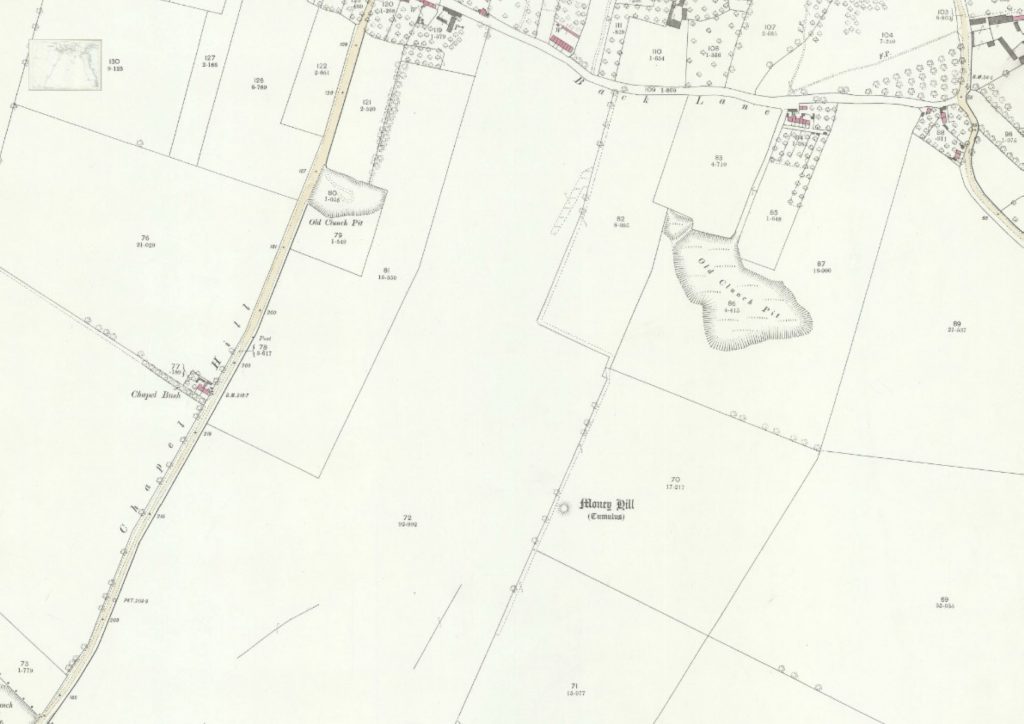
A small roadside cottage known as Chapel Bush stood on the site of the chapel until early in the 20th Century. It can be seen on the Ordnance survey maps from 1887. A bulla of Pope Martin V (1417-1431), a 1 1/2 inch lead disc, was found on the site in 1897.
It is a tradition of All Saints Church to walk up Chapel Hill on Easter morning to witness the dawn. The vicar leads a prayer and a hymn is sung around a lighted brazier. A flame from the brazier is taken down to the church in a lantern from which the Paschal candle is lit at the Easter morning service.
The experience is deeply moving and a truly ancient link to the past. Chapel Hill, to me personally, is as significant as Avebury or Stonehenge. It is such a spiritual and significant point as the flat area of Cambridge and fenland stretch out before us. For 700 years the church has nestled at the base of the hill where thousands trod on their way to the awe inspiring Ely Cathedral.
The image of a railway cutting slicing through the hill and stretching out over the fields and over the river to Harston is truly appalling. A desecration of this region’s history and the first chalk hill rising out of the flat landscape of Cambridgeshire.
Jennifer Gore, Churchwarden, All Saints Haslingfield
Chapel Hill in the Setting of All Saints Haslingfield1897 OS map showing Chapel Bush which was the pilgrimage site and the tumulus on neighbouring Money Hill one of 5 barrows up there. The proposed railway cutting will go between them.
Dear fellow resident of the Sawston and Shelfords division for the upcoming Cambridgeshire County Council elections,
The Shelfords EWR Action Group is delighted to invite you to a hustings for the above election to hear the candidates answer questions on the recent consultation launched by East West Railway Company.
The event will be held via Zoom at 7pm on Sunday 18th April and will require prior registration. Please follow this link to register and you will receive an email to join the meeting.
The candidates are as follows:
Conservative Manas Deb
Conservative Dale Hargrove
Green Sophie Berridge
Green Ellie Crane
Labour Tracey Draper
Labour Anand Pillai
Liberal Democrat Maria King
Liberal Democrat Brian Milnes
During the hustings, the candidates will be asked in turn six questions (of which they will have prior notification) with 2.5 minutes for each Party to answer. In the remaining time, the Moderator will pick a small number of relevant questions posed by the attendees in the chat facility to put to the candidates, again with 2.5 minutes to answer per party.
Our division includes Haslingfield, Harston, Newton, Hauxton, Little Shelford and Great Shelford, through which EWR’s preferred route option runs. The division also includes Stapleford and Sawston, which will also feel the effect of EWR’s plans. We are certain you will want to hear the candidates thoughts on the plans and what they intend to do, if elected.
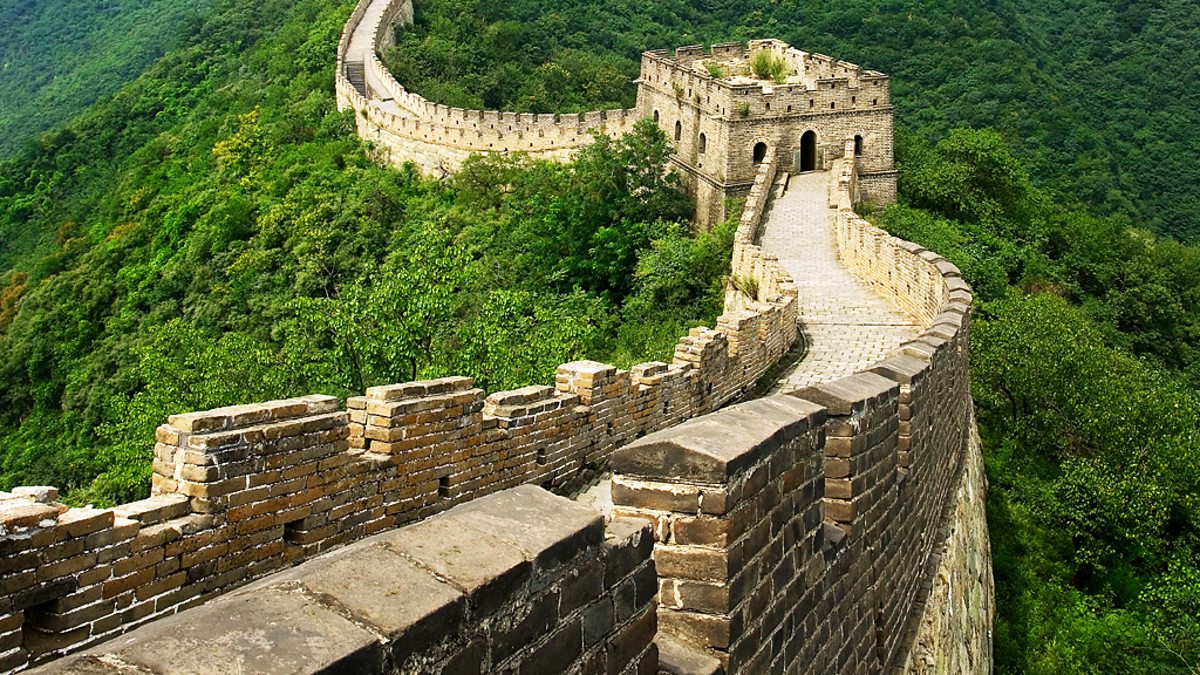
The Great Wall of China – longer, but not as high or wide as what EWR Co. are proposing.
From the highly skewed A428 dual carriageway bridge near Highfields Caldecote in the west to the huge, grade-separated Hauxton junction in the east, EWR are proposing to build a Great Wall across rural south Cambridgeshire.
Because the taxpayer is not given a choice on the matter, this 16-kilometre long feature is barely mentioned in the 2021 consultation document, but it does emerge from a study of their long section drawings here and here. Aside from the massive visual impact and the noise, this feature could split communities that have stood for a thousand years. It could disrupt local travel patterns for school children and adults, destroy precious farmland and cause the protected Wimpole Barbastelles to move away.
The loss in local property values is already enormous and EWRCo.’s proposed blight policy will not even scratch the surface in terms of compensation.
We understand from EWR Co. engineers, that their key design driver is to maintain the speed of the railway. It follows that it needs to be straight and level where possible. This is to serve 100mph trains all the way from Oxford to Cambridge. But the forecasted number of people per train making this trip is only o.7 perhaps rising to 1.9 on average. [18,000 trips/year, 18 x 4 trains / day see 2019 EWR Co. Technical Report §4.11]. Can someone please explain the logic of this? EWR Co. tell us 75% of the traffic will be local and that they are surprised by this. If that’s correct why on earth has it not affected the design criteria? It looks like a symptom of a boondoggle. Please build something to serve the local demand – not a bullet train on a great wall.
Cross-Section of The Great Wall
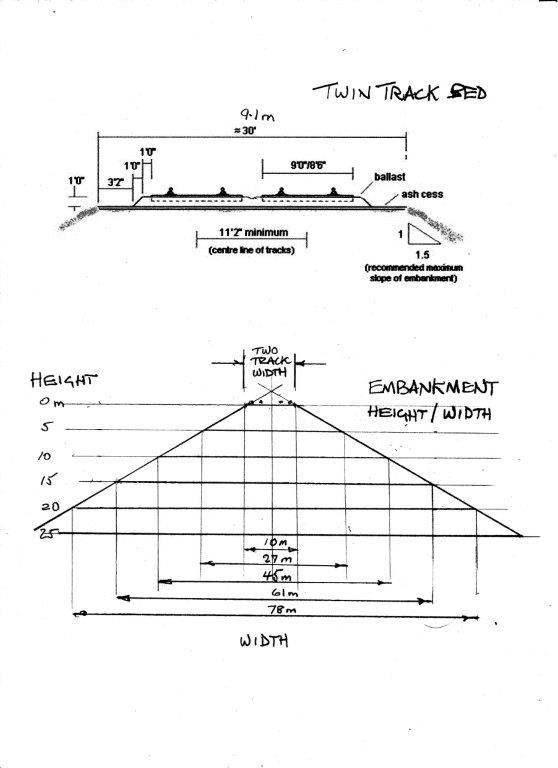
The Great Wall is of course a railway embankment and we understand that their typical cross-section is as shown in fig.1 below.
Fig.1 Cross Section of The Great Wall – a twin track railway embankment. (Courtesy of Steve Edmondson).
Looking at the long section diagrams linked to above we can see that the embankment height mostly in the range 5-12 metres. So we can expect the width at the base to be around 30 to 50 metres.
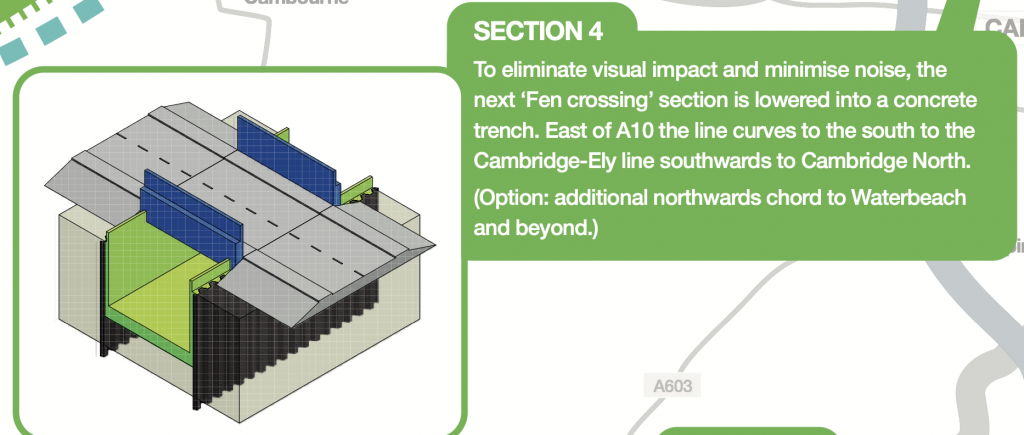
Our previous post on farmland impact assumed an 8m width. EWR Co are also reserving land either side of the Great Wall for construction access. We assume that the flatter land to the north of Cambridge would not need such high embankments. EWR Co. might also consider some innovation there by sinking the railway into a trench as proposed by cambedrailroad.org and shown in Fig.2
Fig. 2 Cambedrailroad’s Fen Crossing Proposal. If EWR Co. can’t afford this perhaps they should build something with a business case that can.
Photographer’s Impressions of The Great Wall
We asked a local photographer to create some impressions of what The Great Wall might look like in the section between Little Eversden and Haslingfield. These have been created from very recent photographs combined with railway embankments from elsewhere.
These mockups (figures 3, 5 & 7) are approximate but they do give an impression of what The Great Wall would be like. Also shown are the views from the same locations today (figures 4, 6 & 8).
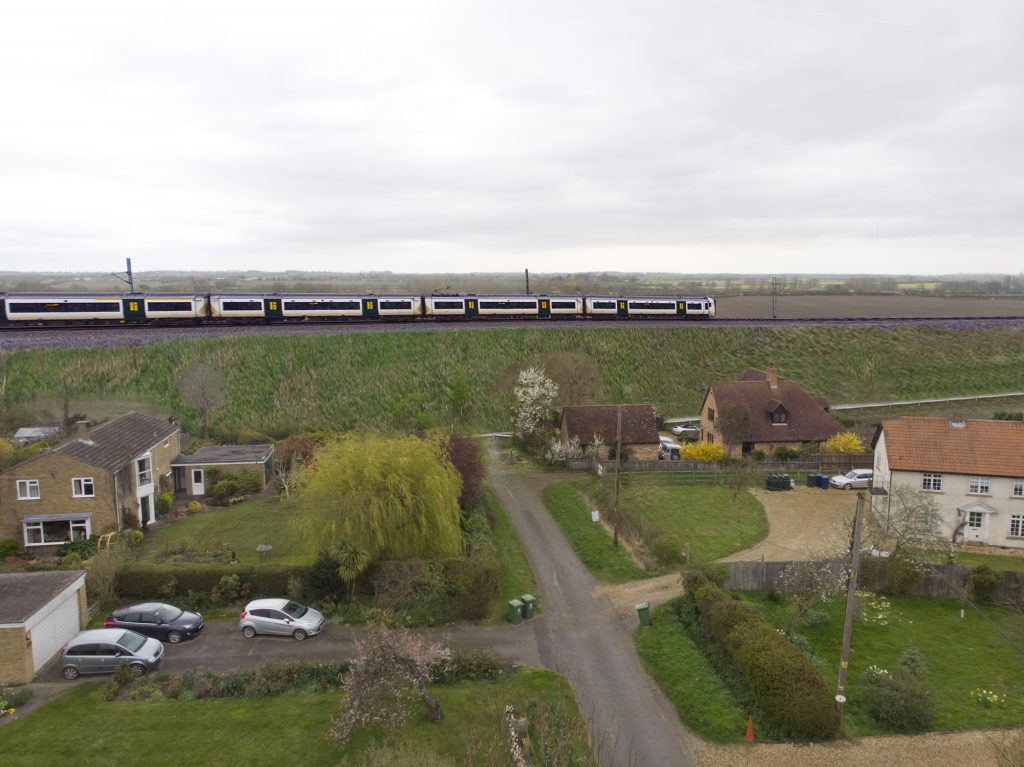
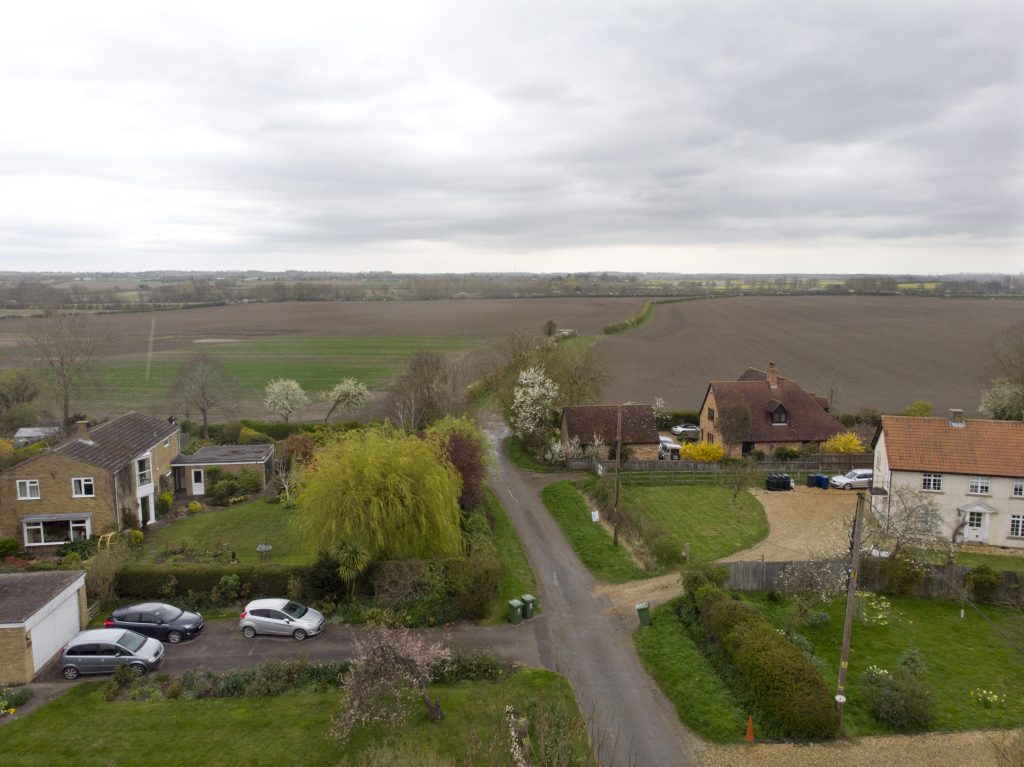
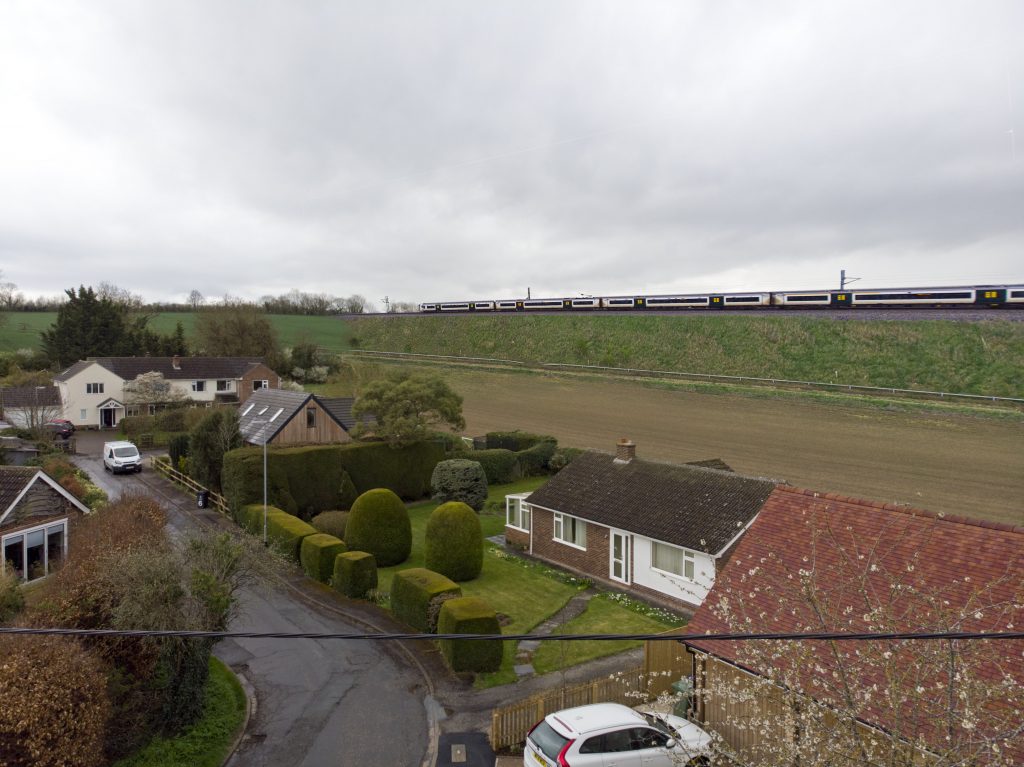
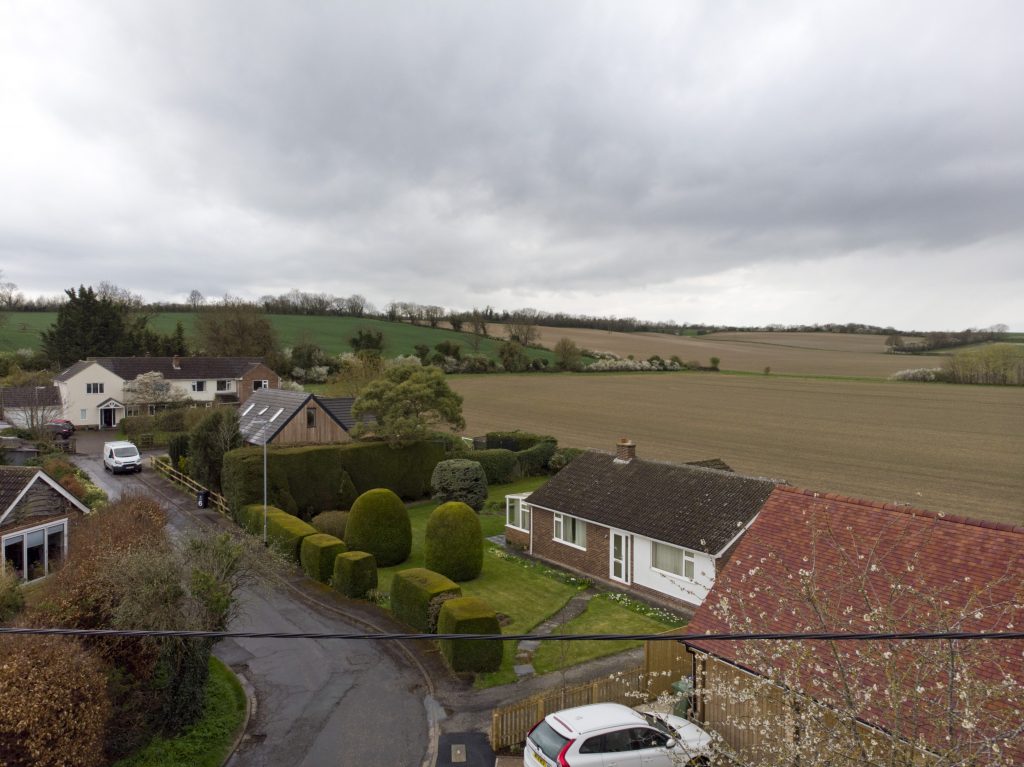
Fig. 3 View North from the End of Lowfields in Little Eversden.Fig. 4 View north from the end of Lowfields Little Eversden before The Great WallFig. 5 View East towards Haslingfield from Harlton. We await confirmation that there will be an underpass for access to Haslingfield e.g. for children to get to school. Perhaps through a 50m long dank tunnel.Fig. 6 View towards Haslingfield from Harlton before The Great WallFig.7 View South West from Wells Close Haslingfield. The Great Wall would actually be more across the picture as it carves into beautiful Chapel Hill.Fig.8 View from Wells Close Haslingfield towards beautiful Chapel Hill before The Great Wall.
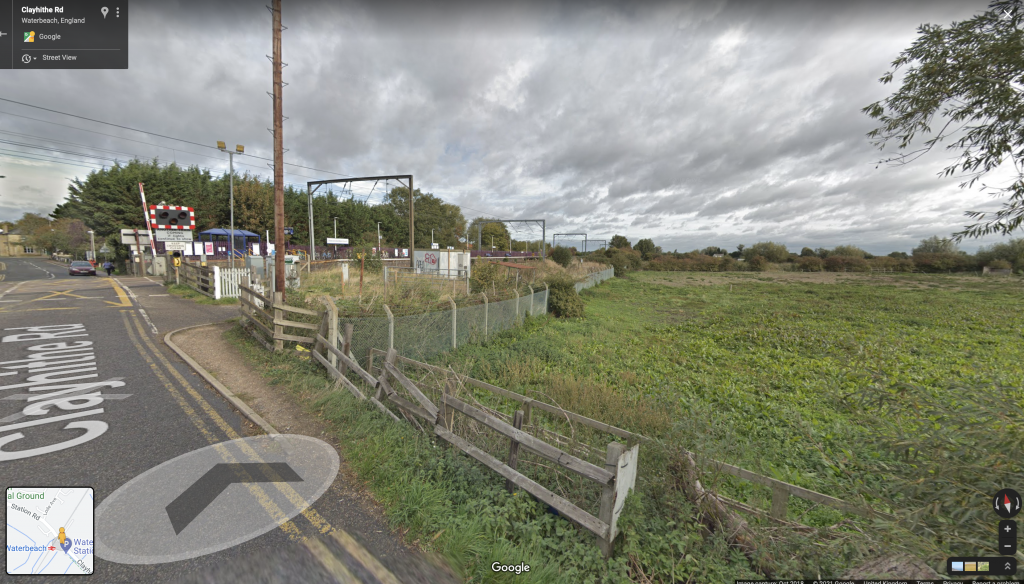
The West Anglia Mainline (WAML) at Clayhithe
Fig. 9 The West Anglia Mainline at Clayhithe very close to the river Cam.
To get a feeling for the likely height of embankments required north of Cambridge here is a view (fig.9) of the existing WAML about 300m from the river Cam. It’s not easy to see but there is actually an embankment there. Notice also that the overhead lines are below tree height thus shielding the view from the houses behind them.
That’s not the end of the impact of this proposal by a long way, but it is enough for this post.
The second non-statutory consultation from EWRCo. came out on the 31st of March 2021 just before the Easter break. As you may imagine the Cambridge Approaches team has been very busy since then and we are conscious that we have not updated this blog about it. We did make some initial comments in the Cambridge Independent here and on the ITV news. There is plenty of coverage in today’s Cambridge Independent (7th April 2021) and no doubt this will appear on line in due course. Suffice it to say it is far from the fair consultation on a northern route into Cambridge that we are campaigning for.
Harston Area Webinar
We are continuing our series of spring webinars with one for the Harston area. People from other villages are very welcome too. This will be at 7pm on Monday 19th April 2021 when Dr. William Harrold and Cllr. Sebastian Kindersley will present on “the need for a fair consultation on a northern route to Cambridge”.
To register for this webinar please use this link.
After registering, you will receive a confirmation email containing information about joining the meeting.
Note that our webinar programme is now maintained here.
Meetings Organised by Our MP
Anthony Browne has invited Cambridge Approaches and CBRR to participate in the following public meetings on the subject of East West Rail:
Great Shelford: Tuesday 20th April at 6pm – 7pm
Eversdens, Haslingfield, Harlton, Harston, Hauxton, Little Shelford & Newton: Wednesday 21st April at 6pm – 7.30pm
Bourn, Caxton, Cambourne, Comberton, Toft, Highfields Caldecote, Hardwick, Kingston and Toft: Thursday 29th April at 6pm – 7pm
These meetings will be via ABs Facebook and Youtube pages and details will be provided at www.anthonybrowne.org/east-west-rail
Fundraising
For the last six months Cambridge Approaches, supported by the working group have been looking to challenge EWR’s decision not to consult in parity on a northern approach by way of a judicial review.
We have instructed expert lawyers, taken advice and have been actively fundraising from parish councils and private donors to kick start that process.
Legally we may only have a small window in which to challenge EWR and we have to be prompt when doing so. We believe that this could be our window and we have to be able to demonstrate to a judge that we have funds in place to be able to proceed.
Time is now of the essence
We currently need substantial donations from residents to reach our target. We aimed to raise £50k from supportive parish councils and a further £30K from concerned residents, we currently need substantial donations from residents to hit this target.
Donations of over £250 can be donated directly to Cambridge Approaches ltd (email info@cambridgeapproaches.org) we have created a not for profit company limited by guarantee to handle donations. Should there be any unused funds donated in this way they can be refunded pro rata, further details can be given with regards to this process.
Alternatively we also have created a go fund me page where donations of any size are welcomed and will be used towards both our campaign costs (hiring experts to carry out detailed assessments, Royal Mail outs etc) as well as going towards the judicial review costs.
The Cambridge Approaches legal team is very privileged to be joined by David Feldman.
David has taught, researched, written about and adjudicated in relation to law, especially constitutional and administrative law and human rights, including historical, comparative and philosophical aspects, for over 45 years.
He has held many prestigious posts including Legal Adviser, Parliamentary Joint Select Committee on Human Rights, 2000-2004, Judge of the Constitutional Court of Bosnia and Herzegovina, 2002-2010 (a Vice-President 2006-2009) and Rouse Ball Professor of English Law, University of Cambridge, 2004-2018 (now Emeritus). He is an Academic Associate at 39 Essex Chambers, London and was elected Hon. Bencher at Lincoln’s Inn in 2003, elected FBA in 2006, appointed Hon. Q.C. in 2008 and awarded Hon. LL.D. from the University of Bristol in 2013.
He is the author of a large number of books, articles, chapters and shorter works on many aspects of public, private and criminal law and procedure, including Civil Liberties and Human Rights in England and Wales 2nd edn (OUP, 2002), (as Ed.) English Public Law 2nd edn (OUP, 2009), and (as Ed.) Law in Politics, Politics in Law (Hart, 2013).
This post looks at East West Rail Company’s (EWR Co’s) arguments for rejecting a northern approach proposed by CamBedRailRoad (CBRR) and to provide the evidence to rebut their claims.
EWR Co presented their reasons in chapter 16 of the Preferred Route Option Report, issued in January 2020. (Preferred-Route-Option-Report)
They briefly set out the historic development of the approach into Cambridge from the south – it was based on Network Rail’s assessment in 2014 which was never discussed or consulted on with the public. EWR Co state that they have reviewed this decision before the last public consultation and that it ‘appeared to remain sound’.
Chapter 16 goes on to infer that the public supported this approach. Cambridge Approaches have already reviewed this claim in a previous post (CA post – fair consultation) and consider it to be flawed. In essence, EWR Co stated that a third of responses did not express a view, with the other two-thirds being broadly evenly split between agreeing and disagreeing with EWR Co’s decision to prioritise route options that approach Cambridge from the south and so implying that there no significant opposition to it. In fact, Cambridge Approaches more detailed and specific analysis from parish councils (which we took as proxy for public opinion) shows that almost three quarters of these parish councils either expressed a desire for a consultation on a northern approach (54%) or that there was insufficient information (17%) to make a choice.
Before we go on to review EWR Co’s arguments, we note that they have specifically removed the chord (track connection) proposed by CBRR on Coldham’s Common claiming that it:
would not serve Cambridge Station (it is not intended to serve Cambridge Station, at least for freight)
it would increase the capital cost of the project (yes, marginally, but needs to be assessed against the overall cost of the entire route options which we believe favours a northern approach)
it passes through a County Wildlife Site (yes, but again it needs to be balanced against all the other environmental sites of each approach option – a northern approach won convincingly when this was done (CA post – environmental-impact)).
In fact, this chord is essential to enable a connection from the north to connect with the eastern section of EWR without freight having to make a physical reversing move. Removing it implies that they did not understand how the CBRR route would function.
EWR Co have five main ‘selection criteria’ against which they claim all options are assessed. They have assessed the CBRR route against these criteria and use them as arguments for rejecting a northern approach. The criteria are:
Benefits for transport users
Supporting economic growth
Supporting delivery of new homes
Costs and overall affordability
Environmental impacts and opportunities.
16.19-22 – Benefits for transport users
From EWR Co’s analysis of including the CBRR-proposed stations at Northstowe and Cambridge North into their transport model, their conclusion is that the transport user benefits of a northern approach are £200m greater than a southern approach!
They go on to state that approaching Cambridge from the north would require a reversing move at Cambridge station for any onward journeys to/from Ipswich, and to/from Norwich and that this would increase journey times. However, EWR Co state in their Technical Report (EWR-Technical-Report)
‘Onwards services to and from the east of Cambridge (for example to and from Norwich and Ipswich) are not currently included in the indicative train service specification for EWR services and are thus not part of EWR Co’s remit.’
We therefore wonder why this scenario is presented as an argument against a northern route. If additional services are included at a later stage, it is equally possible that onward services to Stansted could be included for which the CBRR route would be considerably more suitable than a southern approach. And again, they have removed the chord on Coldham’s Common that would allow freight trains to avoid such a reversing move.
16.23-25 – Supporting economic growth
EWR Co’s own conclusion on this ‘argument’ states:
‘The economic and employment opportunities provided around Cambridge North station and the proposed Cambridge South station are considered to be similar in nature and scale.’
There is, thus, no case to argue.
16.26-27 – Supporting delivery of new homes
EWR Co state in their argument that a northern approach would support the delivery of 10,000 homes that are planned at Northstowe. As this is one of the biggest housing developments in the UK since Milton Keynes, EWR Co seem to agree with us that this is a most convincing argument for a northern approach.
They go on to state that:
‘responses to the consultation did not identify any additional housing sites that could be supported if EWR were to approach Cambridge from the north’.
Below is schematic produced by CBRR showing existing, proposed and putative housing developments in the area. The black line is CBRR’s indicative route. The size of the circles represents the population of each site. To be fair, some of these sites have only come to light as a result of the publication of the call for sites by South Cambridgeshire District Council and that publication post-dates the option E decision. But this is the ‘new information’ that EWR Co have said they would need to if they were to reconsider the approach into Cambridge.
At a stroke, this contradicts EWR Co’s argument regarding supporting delivery of new homes. The schematic shows:
more new housing developments along the CBRR route than along the southern Option E one
more developments to the north of the Option E area near Cambourne and so provides justification for a north Cambourne station
a void of new housing development sites over the bulk of the Option E area.
Worryingly, EWR Co further state that:
‘Moreover, South Cambridgeshire District Council stated a preference for a route via Cambourne (Route E) that approaches Cambridge from the south.’
In fact, nowhere in SCDC’s response did they explicitly favour a southern approach over a northern approach. They supported Options B and E because they wanted EWR to serve Cambourne rather than Bassingbourn, not because it approached Cambridge from the south. They have highlighted the lack of information which would be required in order to make this decision.
‘Acknowledging the broad nature of this consultation, limited information available and significant uncertainties around growth implications, it is considered that, in principle, routes including Cambourne as a station (B and E) could be preferable to routes including Bassingbourn, for the following reasons:’ [SCDC’s underlining]
This is hardly the support that EWR Co imply.
16.28-31 – Costs and overall affordability
EWR Co consider that the upfront capital costs of the CBRR route is £600m more expensive than a southern approach. Given that the new track lengths may be broadly similar (depending on which southern alignment is chosen) and that a northern approach has about one third the number of road crossings, no river crossings and easier topography, we consider that a northerly approach may be cheaper to build than a southern approach, even allowing for a station at Northstowe.
EWR Co make allowance in their costings for crossing a new rowing lake north of Cambridge. However, the planning application for this rowing lake was withdrawn about 18 months before the EWR Co options report was published. It is therefore not an obstacle to the CBRR route.
However, the capital costs are only part of the financial picture. Revenues are the other part of the equation. EWR Co state:
‘The CBRR-based route would generate slightly higher revenues than Route B. However, these higher revenues are mostly offset by higher operating costs and whole life costs arising from the longer route and additional station at Northstowe.’ [CA underlining]
The word ‘mostly’ implies that, in fact, the greater revenues from the CBRR route more than compensate for any EWR Co-claimed additional construction costs.
16.32-34 – Environmental impacts and opportunities
The argument presented for the environment just lists issues with the northern approach. It makes no mention of the environmental impacts for a southern approach yet goes on to claim that:
‘A higher level of effort is therefore likely to be required to mitigate the effects of the presence of multiple environmental features compared to route options that approach Cambridge from the south.’
Not only is this illogical as they only present one side of the argument, but it flies in the face of the Wildlife Trust’s analysis. This clearly shows [CA post – environmental-impact] that there are approximately twice the number of environmental sites affected by a southern route than a northern one. The conclusion that a northern approach is more environmentally friendly is supported by Natural England, Cambridge Past, Present and Future and the Campaign for Rural England support northern approach. These organisations, unlike EWR Co who are based in Milton Keynes and Westminster, know the area well.
Not mentioned by EWR Co, but vitally important to residents, is the relative environmental noise and air quality impact of the two approaches. There are approximately 7 times (yes!) the number of properties within 200m of a representative southern route than the CBRR route.
Conclusions
In summary, we believe that EWR Co have a poor case for their approach into Cambridge. Far from justifying a southern approach, the evidence that we have provided strongly supports a northern approach. We have pointed all this out to EWR Co both in writing and at a recent meeting with the rail minister, Chris Heaton-Harris. Despite Mr Harris requesting that EWR respond promptly, we have yet (as of 16 March 21) to receive any reply.
Iwrote recently about the situation regarding the Oxford to Ipswich East West Rail link.We are hosting a webinar on this subject especially for those to the east of Cambridge. This webinar will be specifically about the effect that the new rail route will have on the Cambridge to Newmarket corridor area.Whilst we understand that it might seem a fairly benign development, and indeed more frequent train services are to be welcomed, the railway line will dramatically affect the corridor. The webinar will focus on the effects that the new rail route will have, how you can find out more and on the alternatives available.For those for who have not been following events, we will also give some history of the project, and try to demystify the way that it has evolved since inception back in 1997. There will be plenty of opportunity to ask questions as well.The webinar will be on Tuesday 16th March at 7pm. You can use the link below, or visit the Cambridge Approaches website and register from there.
You are invited to a Zoom meeting. When: Mar 16, 2021 07:00 PM Greenwich Mean Time Register in advance for this meeting:
“However, we are seeking views through this consultation on whether we are right to focus on routes that approach Cambridge from the south. Of the five route options that are being taken forward for consultation, Routes B and E could alternatively approach Cambridge from the north if new information is provided that suggests this would be better than approaching Cambridge from the south.”
The 2019 EWR Co. consultation form asked for views on five route options all approaching Cambridge from the south. In addition, they asked “Do you agree that EWR Co are right to prioritise route options that approach Cambridge from the south rather than from the north?”
EWR Co. presented statistics on the answer to this leading question in January 2020. A slight majority disagreed (37% vs 35%). This is hardly a sign that EWR Co. have got it right.
We decided to probe a bit further into the consultation responses.
Northern Parishes not Consulted
We found that parishes to the north of Cambridge and the A428 were not even consulted about a northern approach. We know this because the 2020 Public Feedback Report lists the prescribed consultees and does not include these parishes – see Appendix 2a starting on p.8. Furthermore, no maps of the potential northern approach were presented in the consultation. This hardly facilitates EWR Co.’s request for new information about a northern approach to be provided by the consultees. Where is the new information going to come from if you don’t actually consult to the north? and shouldn’t EWR Co. have had a more detailed look at the northern approach themselves and presented the information to the public in an impartial way rather than relying on the public to do their own research? There was certainly no parity here compared with the consultation on the approaches to the south.
“In answer to your comment around the various requests you have received from constituents for a consultation to be held on whether East West Rail should approach from the south or the north, please let me clarify that this point has been to a full public consultation as part of our first non-statutory consultation held between 28 January and March 11 2019.” (Our emphasis).
Are EWR Co. attempting rewrite history here?
How well were People in the Option E Area Consulted?
There were no consultation meetings held in the Option E area in between Cambourne and Cambridge. Cambridge Approaches can attest that the level of awareness of the consultation among the general public in this area in the second half of 2020 was very low – our leaflet and webinars were the first that many people had heard of it. Shockingly, most of the few that were aware heard about it through survey requests from EWR Co’s agents, Ardent.
Most of the discussion during the consultation centred on routes through Bassingbourn rather than Cambourne.
Maybe it was different in Cambourne and further west, but judging from recent activity in Option E parishes north of Bedford, they were in the dark as well. For example, the village of Ravensden is bang in the line of Option E, but does not appear in the list of statutory consultees. Why is that?
Parish Council Responses
Perhaps the best proxy we have for public opinion on the route options at the time of the 2019 consultation comes from the parish council responses that were sent in.
EWR Co. listed 70 parish councils as prescribed consultees and a year later they published the responses from 41 of these councils here (starting on page 63). Figure 2 shows a map of which parish councils responded. Perhaps one of the more surprising things on the map is the lack of response from Great Shelford and surrounding parishes[1] which EWR Co knew (because they said so on p. 20 of their consultation document) would be affected by any route option chosen. Despite the parish being listed as a prescribed consultee, the parish clerk to Great Shelford PC did not receive a letter notifying the parish council of the consultation.
Figure 2 Which Parish Councils Responded
In the consultation, the parish councils were faced with a choice between route options A to E. This choice involved deciding on at least three issues:
The route out of Bedford south (A, B, C) or north (D, E)
Bassingbourn (A, C, D) or Cambourne (B, E) station as the last stop before Cambridge
Cambridge approached from the south (A, B, C, D, E) or the north (-)
We have been through the response letters sent in by parish councils. We first looked at whether they supported a northern approach into Cambridge or whether they at least thought there should be a proper consultation about it. Then, we counted the parishes that responded but did not express a preference because they (very understandably) felt that the consultation did not provide enough information.
Finally, we counted the parishes preferring a route through Bassingbourn (routes A, C, D) and separately through Cambourne (routes B, E). In doing this, we noted that only one parish east of Cambourne (based on the dotted black line in Figure 2[2]) supported a southern option with a station at Cambourne.
Figure 3 shows the results.
Figure 3 Analysis of Parish Council Responses
Hardly a resounding endorsement of option E with a southern approach to Cambridge.
The Elephant in the Room
Figure 3 shows that the largest proportion of parish council responses (54%) either expressed a preference for a northern approach to Cambridge or at least felt there should be a proper consultation about it. This was not even a consultation option, but it was the most common response.
That is the elephant in the room which EWR Co. ignored in choosing their preferred route option (and continue to ignore).
They just presented option E as the most popular choice and re-stated their reasons for not following the northern approach in a slightly longer form[3] than they did at the time of the consultation.
Yes, parish councils were influenced by the campaign of CBRR. But that’s because CBRR were making, and continue to make, good arguments for their northern approach to Cambridge.
The next most common response from parishes (17%) was to say that the consultation did not provide enough information to express a preference.
So nearly three quarters of the responses did not support any of the southern options A to E. Shouldn’t that tell EWR Co. that they need to think hard about the next step in the consultation process?
In recent correspondence with EWR Co. we were informed that they intend to present more analysis of the northern approach to Cambridge in their next consultation as they consult on detailed route alignments in the option E area. It seems that they have not listened to the feedback from the parishes at all.
[2] The logic for this division was that parishes east of Cambourne would be more informed and concerned about the route into Cambridge than those parishes further west.