It’s time to ask again for a fair evaluation the EWR approach into Cambridge either to a north or south station. There are problems with the selection of option E which have been flagged on this site, in our stakeholder meetings and elsewhere.
CamBedRailRoad started a petition before the last EWR Co. consultation with the right question. Their petition to the Department for Transport already has more signatures than the number of people who supported option E in the consultation response.
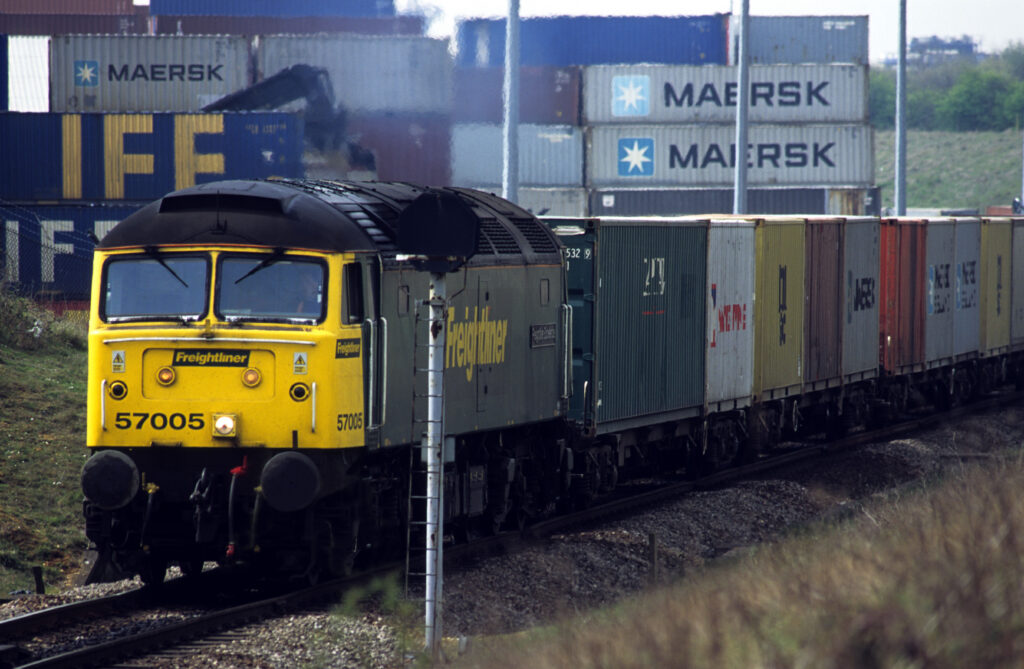
AC7XAK Freightliner freight train, pulling out of the North rail freight terminal, Port of Felixstowe, Suffolk, UK.. Image shot 04/2007. Exact date unknown.
We sent a batch of questions (numbered 25-34) to the East West Rail Company on the 22nd October 2020. After some chasing we received the following answers on the 19th November 2020.
We sent questions associated with the unexplained cost increases post to EWR Co. at the same time that we put them on this web site. There should be a fundamental review of the validity any project who cost has tripled in 12 months!
We have also asked about why we can’t see the results of the publicly funded environmental surveys conducted so far. They say it’s GDPR, however, we have cases where they won’t even share the results with the landowner who land is being surveyed. Lack of transparency is never good especially with public money. What do EWR Co. have to hide on this?
There is difference in emphasis between verbal assurances and written answers given by the East West Rail Company. For example, we have heard on more than one occasion verbally, that roads and rights of way cut by the railway would be restored unless it was just about impossible to do so (Ian Parker at the “Let’s Restart the Conversation” meeting, Will Gallagher at the CA-EWR meeting with Anthony Browne). The “substantive response” to the same question talks about each crossing being dealt with on an individual basis. A lot less reassuring.
Again the substantive answers from EWR Co. are less reassuring. The line will be freight capable and they are exploring what freight services might be offered including night time operation.
“East West Rail presents a huge opportunity to become a secondary freight route, enabling more services to bypass congested London routes currently used to get to the South West, Midlands and the North. It also presents an opportunity to move aggregates for the development of new housing and nationally significant projects, such as Sizewell C.”
An earlier response from EWR Co. on the subject of freight received by a member of the CA working group ran as follows:
“In relation to your question about freight, we are currently designing the route to be compatible for both passenger and freight services in the future. We will look to ensure the route supports existing freight, and are currently undertaking a study to understand potential freight use.
The remit we’ve been given by the Department for Transport covers the infrastructure between Oxford and Cambridge, opening up new, long-distance journeys for people who can both take advantage of the EWR services or change directly onto main lines coming north/south the majority of which inter-change with the route. We continue to work to ensure that EWR enables good connectivity beyond the area between Oxford and Cambridge. There’s nothing in our plans that would preclude us from expanding our remit were the Secretary of State to request it.
We’re aware of proposals for EWR services to be extended further east from Cambridge into Norwich/Ipswich and beyond – specifically, the proposals put forward by the East West Rail Consortium in their publication “the Eastern Section Prospectus for Growth” published in January 2019. We look forward to hearing how this progresses.”
The implication here is that they have a very passive involvement with freight while the people developing the business case for freight services on the eastern section, do not have to face any scrutiny from the people affected by the new railway central section. The situation is deceptive – which is why we are pointing it out.
There was no mention of freight services in the 2019 EWR Co. consultation, but it now emerges that freight may well be significant. If, like me, you are skeptical about the demand for commuting between Oxford and Cambridge, freight may in fact end up being the dominant user of the line. The implication is that the 2019 EWR Co. consultation was misleading and hence invalid because it did not mention freight.
It is also interesting to learn that no Strategic Environmental Assessment has been performed, because they do not need one. Why is that? We have a lot more to say about the environmental side of this. Stay tuned.
Following on from the very well attended Eversdens meeting on 17th November, thank you for the huge turnout for the 4 villages webinar on Friday. A recording for those people that missed it is here.
Some free Advice for EWR Co. about the Route Alignment, this time on the A603.
CA was invited to present to an Eversdens meeting on the 17t November with CBRR and Cllr Van De Weyer, deputy leader of SCDC. The meeting was very well attended and it was clear that there is considerable public opposition to the Option E decision in The Eversdens.
These webinars will be slightly tailored to address issues for the local parishes mentioned, but all are welcome. They follow on from the series of webinars we gave back in September and reflect our latest understanding of the situation.
There will be presentations from some of the members of the CA working group followed by a Q&A session. The 20th November webinar is currently near capacity so if you miss it, do feel free to register for one of these other ones.
Some More Concerned Residents of the Option E area. These ones are Legally Protected.
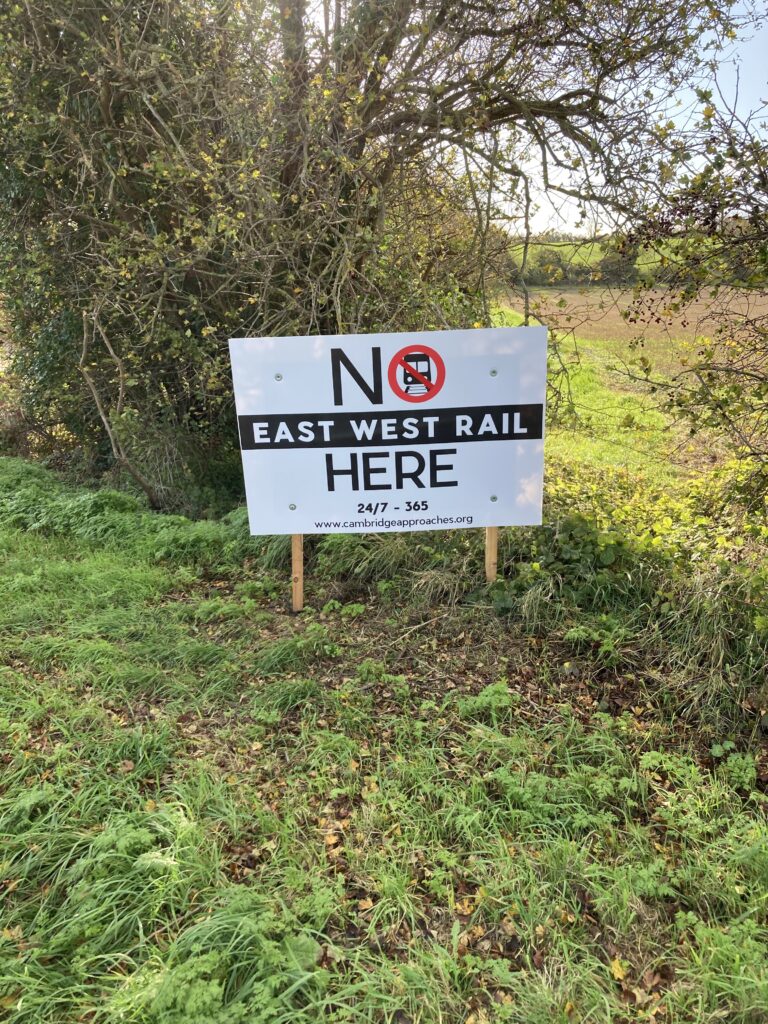
Another CA Poster – see details at the end of this post for how to get one for your village.
Cambridge Approaches have made some progress since our last round of webinars back in September. We would like to do an updated webinar initially for residents of The Eversdens, Harlton, Haslingfield and Harston and in conjunction with parish councillors from these villages.
The presentation will be led by David Revell of Cambridge Approaches who is a civil engineer with extensive experience of railway construction and a resident of the area. He will be supported by other CA members of the working and oversight group as necessary.
As before, there will be ample opportunity for residents to ask questions.
If you have a site for one of these large posters and would like one please email info@cambridgeapproaches.org. They are quite expensive (£40 each) which is the cost we pay to the printer. But in the right place they can be very effective at spreading the word and letting people know how we feel.
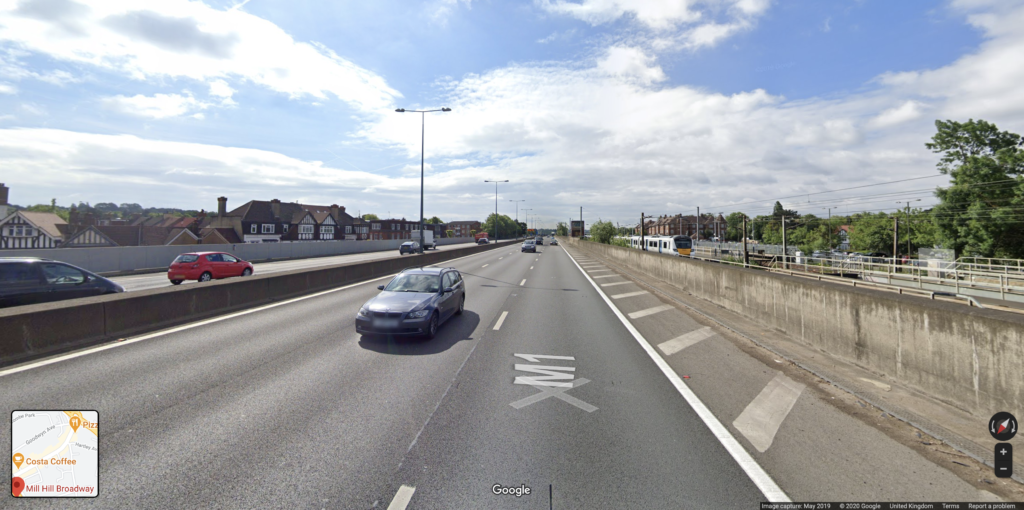
Road and Rail in the Same Corridor. M1 near Mill Hill
Cambridge Approaches is pleased to see the recent “announcement of new a off-road route for the C2C guided busway” between Cambourne and Cambridge, partly along the north side of the A428. The guided bus and Metro would relieve the pressure on local transport systems and shows a great example of joint planning by using multi-modal design where different forms of transport use the same corridors. We need to see more of this type of planning.
The National Infrastructure Commission report “Partnering for Prosperity” encapsulates the transport vision for the Oxford – Milton Keynes – Cambridge Arc. “The proposed East West Rail and Oxford-Cambridge Expressway projects would provide a step change in connectivity across the arc, linking its major economic centres in a way not seen for over half a century.
“These schemes, taken together, have the potential to create a multi-modal transport spine, which through new stations and junctions, can enable the creation of new communities.”
Multi-modal transport spines or corridors have several benefits. They can:
allow passengers to easily change between modes of transport: car, train, bus, cycle, walking and metro
reduce the impact on villages and the surrounding countryside / urban landscape in several ways: noise, visual, farming, severance of roads and rights of way, listed buildings, historical sites, wildlife reserves and the beautiful countryside we all appreciate
allow a better alignment with local development plans
offer opportunities for shared infrastructure costs and hence are fiscally efficient.
Cambridge Approaches welcomes the news that East West Rail Company is also looking at a multi-modal corridor and has listened to feedback on the subject. However, they have expressed some general concerns about the use of such a corridor alongside the A428 and the M11 but Cambridge Approaches considers that these are not valid in these locations.
The East West Railway concerns about the practicality of multi-modal spines are shown below with Cambridge Approaches responses:
“• Railways and roads have different tolerance for gradients: roads can climb much more steeply than rail The proposed line is going through reasonably flat countryside.
• Railways and roads have different preferences for curves: road designers tend to prefer to include bends and other features in new roads – avoiding long, straight sections helps to keep drivers alert; railway designers prefer long, straight sections to improve visibility. The A428 and M11 are broadly straight and certainly within the limit of curves for railways.
• Bringing them close in places but diverging in others could result in areas between the two becoming wasted ‘dead land’. With careful planning, the road, rail, bus and bicycle lanes could all stay close together to reduce any dead land. Any unavoidable dead spaces could be used for wildlife protection.
• Creating appropriate access routes for people to cross a combined rail-road corridor could be more challenging than across two separate projects. If the routes for transport are sensibly designed with small areas of dead land between them (see above), continuous bridges crossing will be cheaper than individual bridges crossing separated transport routes.
It may be that for short stretches in specific locations building road and rail close together is the right approach.
We are keen to explore the efficiencies which could be realised from more than one infrastructure project working in the same area at the same time. We are in touch with the team at the A428 and will continue to work with our counterparts at Highways England and your Local Authorities to ensure that the planning and delivery of these transformative projects is coordinated.”
If one wants an example of road and rail side-by-side have a look at the stretch of the M1 from Mill Hill to the north circular road. This was built about 50 years ago; Cambridge Approaches is encouraging EWR Co to persist with using multi modal corridors. Rural south west Cambridgeshire deserves better than the further pillage of the option E area by multiple route corridors for transport that doesn’t serve its communities.
Cambridge Approaches is urging EWR to use existing transport corridors where this is at all practical. Cambridge Approaches is calling on the local politicians and planners to resist attempts by EWR Co to use railway lines outside of existing transport corridors unless essential.
These posters are starting to appear in the Option E area, get in touch if you want one.
It’s been a while since we reviewed the Cambridge Approaches objectives so we felt it was time for an update – here it is.
If there is a case for the East West Railway, we support the route going through a new Cambourne North Station rather than Cambourne South and will continue to make the case for that with stakeholders. In this we are supporting our local MP, the Mayor of the Combined Authority and members of the Local District Council. We call on EWR not to ignore the combined weight of this opinion and the voice of the parishes.
Whichever stops are chosen for the railway, we believe that EWR should consult on the variety of options that it could take through Cambourne North; especially as this is a new location not previously considered or discussed.
Until we have further facts, we remain to be convinced about the case for the East West Railway so the consultation needs to cover all the unresolved issues. For example, the business case is poor and not clearly justified; there is no alignment with the local plan from SCDC and other local authorities; it does not make enough use of multi-modal corridors; it may affect our food security; it causes unnecessary environmental damage and planning blight dividing communities in the process.
We are conscious that some very important decisions were made before the first consultation (now some two years ago) on the need for the railway and its approach to Cambridge and these have not been properly justified or back checked. In particular the co-ordination with other transport initiatives such as the Metro to meet commuter demand is not evident; there is little mention of freight – indeed the story of freight resembles that of Schrodinger’s cat. We will continue to research and question EWR Co. and others on these and any other significant points that arise.
Cambridge Approaches continues to make local people aware of the impending threat to the Option E area and to seek means to reduce or ideally eliminate the impact of the railway on residents and the environment. There is no ideal answer, so we will not elaborate further on alternative route options nor will we try to broker compromises between affected parties – that is EWR Co.’s job and for them to justify the route chosen. However, we will advise on facts if you have a specific question.
A prominent Lib. Dem. District Councillor for the Harston and Comberton Ward (representing the parishes of Barton, Comberton, Coton, Grantchester, Harlton, Harston, Haslingfield, Hauxton, South Trumpington) and recent, narrowly defeated MP candidate has come out supporting a Cambourne North Station for the East West Railway. This is not a party political issue, but it is good to see cross-party support for this. Here is Ian Sollom’s statement:
“An EWR route via Cambourne is undoubtedly right for South Cambs, but in the coming consultation we need to see more options than we saw in the previous one, which had a station only on the south side of Cambourne, and suggested only a single route corridor from there into Cambridge. A well designed and well-placed station to the north side of Cambourne has the potential to be transformative for the community, while a route from there into Cambridge North could be a much better fit for future local development. Both of these options should be included in EWR’s next consultation so the people of South Cambs can have their say on these alternatives.”
So we now have Anthony Browne MP, Mayor James Palmer, Councillor Ian Sollom, the Cambridge Approaches Oversight Group vote from 12 parishes and Cambourne Town Council amongst many others all asking EWR Co. to put a Cambourne North Station into their next Consultation. We have also now heard verbally from EWR Co.’s Will Gallagher and Ian Parker that they are looking closely at a Cambourne North option for the next consultation.
If a Cambourne North route does appear in the next consultation, it seems likely to be popular with all the politicians.
It is also good to see some press coverage of Anthony Browne’s call for a Cambourne North Station in the Cambridge Independent including comment from EWR Co. that they are looking at a Cambourne North Station. The EWR Co. spokeperson said “We are exploring the option for a station in the north of Cambourne as we continue to develop route alignment options, prior to consulting the public early next year.”
Below is a link to the PowerPoint presentation that was used at the meeting with Anthony Browne MP, EWR, SCDC, ‘Option E’ parish council representatives and Cambridge Approaches.
Although there was not unanimity, the majority of parish council representatives:
1) rejected the main body of the Option E area for EWR
You may have noticed an increased level of activity in the area proposed for East West Rail to come from Cambourne to Cambridge South. Survey teams from Arup or EWR Co. looking at the fields, the wildlife and the general environment as a preparation for a new railway line through our countryside.
We have an interactive map that shows survey requests received by landowners but this may now be out of date. Please would you be so kind to look at it and see if your are aware of survey locations not on the map. Be aware of a potential GDPR issue here, so it is better to report on your own land rather than others, but also to report on anything seen on public roads / rights of way.
So, if your land is being surveyed, you have received a request for a survey or you see a survey team on a public highway / right of way that is not recorded please could you update the map?
To add a survey location and label to the map click the add marker icon (a grey balloon shaped icon) under the search box on the map, click the location of the survey and then label it.
This is important as it allows us to have information from which we can detect lines of activity and inform your parish accordingly.
Handling Survey Requests
We are currently reviewing the pros and cons of accepting survey requests.
We really welcome following press release from Anthony Browne supporting a Cambourne North Station for the East West Railway. This position was also the most popular option that came out of the Cambridge Approaches oversight group in a series of seven meetings leading up to the one held on the 8th October. This was attended by Anthony Browne MP, Will Gallagher of East West Rail, Aidan Van De Weyer Deputy Leader of South Cambridgeshire District Council and representatives from the parishes from Bourn to Great Shelford. Cambridge Approaches called on East West Rail to include a Cambourne North route in their next consultation expected in January 2021.
In a recent meeting between the CA working group and Mayor James Palmer he told us that he also supports a Cambourne North station for East West Rail.
A Cambourne North station implies a route similar to the example set out in this post from Cambridge Approaches and has a profound impact on the routing of the railway at it approaches Cambridge. We stress that the CA route is just an example and there is considerable more detailed work to do in threading the route through the various constraints between Cambourne North and Cambridge South.
The MPs press release follows:
“Anthony Browne, MP for South Cambridgeshire, has welcomed news that East-West Rail (EWR) is considering a station to the north of Cambourne and is calling for the option to be included in any future consultation.
As part of a meeting between EWR and local Parish Councillors, chaired and organised by Mr Browne, officials confirmed that the possibility of a railway station to the north of Cambourne was under active consideration.
Mr Browne worked towards securing a northern option as part of his general election campaign and has written to the Secretary of State for Transport on this issue. He is continuing to arrange high-level meetings between senior EWR planners and local representatives.
Twenty-eight Parish Councils were represented at the meeting, which was addressed by the EWR Director of Strategy Will Gallagher, with Program Delivery Director Ian Parker taking questions on the design and implementation of the railway. Ashton Cull, Senior Policy Advisor to Combined Authority Mayor James Palmer was also in attendance.
Several other local concerns were also raised during the meeting, including early electrification of the railway, potential timetabling issues and the environmental impact of the scheme.
Mr Browne commented: “East-West Rail is clearly listening to local opinion and I am delighted to hear they are considering a station north of Cambourne. I’m now calling on them to include any such option as part of a future public consultation.
“I believe there is a very powerful case for a station to the north of Cambourne, where it will avoid many much-loved areas of natural beauty and will provide better connections with other transport links, such as the A428.
“We need better public transport links through South Cambridgeshire, but it is important that any engagement is wide-ranging, transparent and happens as early on in this process as is possible. Residents have the right to know what they can expect from this project.”