Yesterday I attended an event in Portcullis House Westminster. The Transport Select Committee (TSC) has chosen to use East West Rail as a case study for interdepartmental working on major infrastructure projects. Of course, this is because the collaboration has been shambolic as exposed by the NAO investigation report last December. They talked a lot about Cambridge, and I had some side conversations with DfT officials as well. Rail Minister Huw Merriman said that the housing between Bedford and Cambridge would be built anyway so we might as well take some cars off the road by building EWR. Nice spin, but, if the houses are going to be built anyway then what exactly is the financial case for this £8billion railway? Dr. Andy Williams of the Oxford Cambridge Supercluster board was unconcerned about the £4million capital cost per Cambridge Commuter for EWR (£8billion/2000 commuters) and told me it was irrelevant. I guess that’s because it’s the taxpayer funding it not business. Similar reaction from Jon Shortland planning officer in Bedford. He said EWR would bring £15million/year to the Bedford economy. I told him the railway would cost £80million/year just to operate, never mind the cost of capital (£8billion at 5%/year is £400million/year). He told me Bedford does not have to pay so who cares? I do.
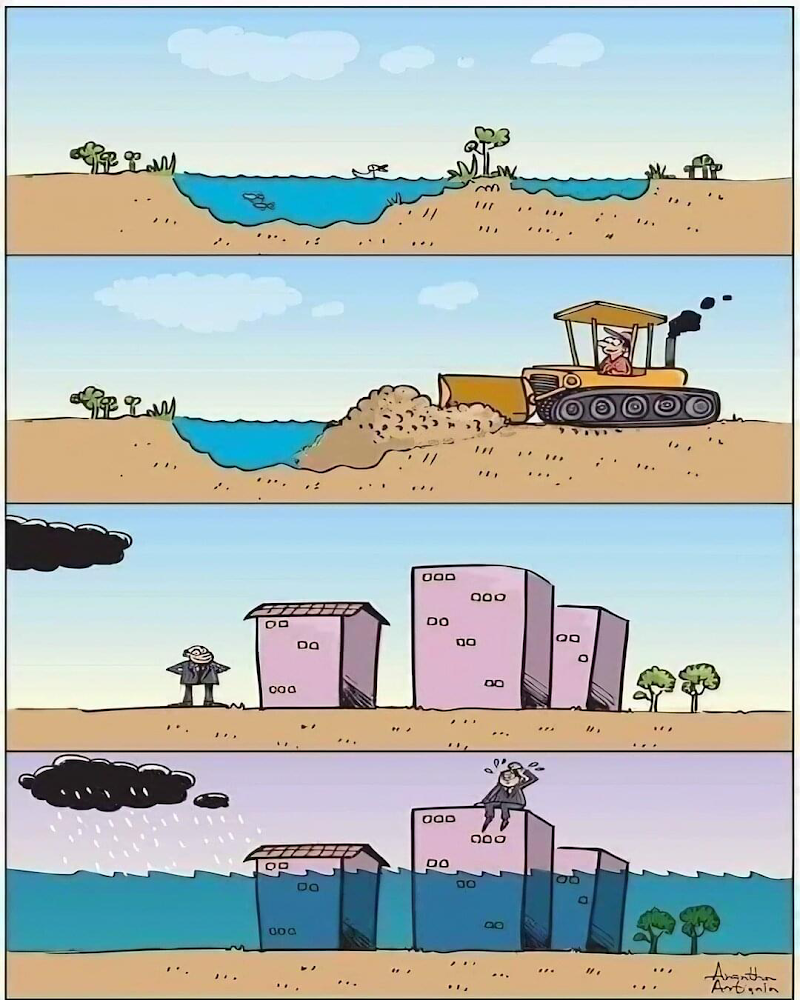
So, then we get to “the miracle at Tempsford” (and presumably similar places like Cambourne North.) and its interaction with the Cambridge Biomedical Campus (CBC). The CBC has 20,000 employees. EWR supporters at the TSC think there could be another 20,000 with EWR connecting to the south of Cambridge. That of course would mean expansion into the green belt towards Great Shelford – a plan rejected by our local planning people so far due to its high harm to our green belt. The problem is that the analysis presented in the EWRCo. Economic and Technical report only predicts 2000 EWR commuters per day to Cambridge, not 20,000 or anything link it. The site at Tempsford is in the flood plain of the Great Ouse and what has to happen is that the three planning authorities that control the area all agree to sign off the new town and that the “rail mode share” at Tempsford is much higher than seen in say Ely or Royston in the 2011 census. They also have to be happy to sign off a dormitory for Cambridge and sort out the environmental consequences.
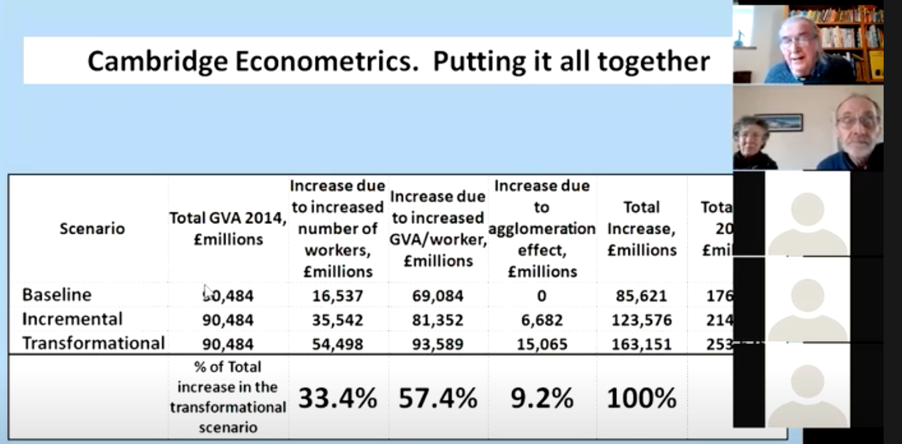
If Tempsford were built it would also connect to Cambridge via the new A428/A421 Black Cat – Caxton Gibbet dual carriageway and of course it is also on a main line railway line to London. Why exactly is everyone going to commute by rail to the CBC? However, the DfT official I spoke to was undaunted. Tempsford will be “transformational” for some reason he could not explain and DfT economists could not analyse. Yeah, right. He also said that the trend to work at home more since the pandemic will double the number of jobs supported because two people go to different jobs. One for say the first half of the week and the other for the second half. My experience is that Cambridge roads are much quieter on a Friday because everyone chooses to work from home. I recall a recent presentation from Stagecoach on their bus passenger numbers saying that “Thursday is the new Friday”.
Dame Bernadette Kelly the Department for Transport Permanent Secretary was asked by the Transport Select Committee why it was that the new HM Treasury led EWR growth board was only now exploring how to deliver the benefits of the railway (she had talked about the 6 new streams of work etc). Why ,they asked, was this not worked out long before the project was inflicted on the general public? She said it was very hard to work out such a business case up front. Evidently much better for local residents to be tortured with years of uncertainty while the DfT use the experience to work out their business case.
Good grief!